

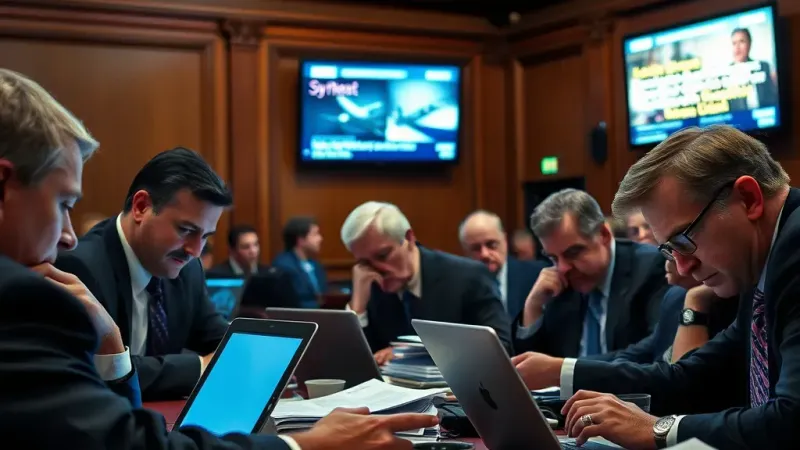
Congress is barreling directly toward a critical December 11 funding deadline, resurrecting familiar government shutdown risks that threaten to upend federal operations, disrupt domestic travel, and severely strain the federal workforce.
The official narrative from Washington generally frames these recurring fiscal cliffs as routine legislative housekeeping, presenting them as a necessary mechanism to keep the lights on while leadership hammers out the final details of year-end appropriations packages.
The catch, as always, is who ultimately bears the brunt of the political brinkmanship while lawmakers spar over ideological red lines. This time around, the legislative fault line runs straight through foreign policy and domestic infrastructure, pitting congressional war powers directly against the daily operations of federal agencies.
A specific bloc of lawmakers has drawn a hard line in the sand, making it clear that they will not rubber-stamp any fiscal package that lacks strict guardrails regarding military engagements abroad. Specifically, Michael Bennet, Bernie Sanders, Chris Van Hollen, and Tammy Duckworth registered their strong opposition to any year-end funding measure that omits critical restrictions. Emphasizing their united stance, Michael Bennet, Bernie Sanders, Chris Van Hollen, and Tammy Duckworth told Just The News - Not The Noise, "Any short-term package must include language that restricts the Trump Administration from using appropriated funds to continue his war against Iran,"
On the other side of the Capitol, congressional leadership is offering a starkly different calculus regarding what is politically achievable under current legislative realities. Opposition to the proposed war funding restrictions has been firmly stated by Tom Cole, signaling that leadership has little appetite for adding foreign policy handcuffs to must-pass spending bills. Underscoring the hard limits of legislative leverage in the face of executive power, Tom Cole told Just The News - Not The Noise, "A Republican Congress is not going to send bills to a Republican president that he’s going to veto,"
When Washington plays high-stakes chicken with government appropriations, the real-world economic consequences quickly cascade down to frontline federal employees who are expected to keep the machinery of government running without reliable funding certainty. The human cost of these standoff cycles is not merely a theoretical talking point for budget debates; it leaves a measurable, lasting scar on agency headcounts and morale. Past funding crises have proven particularly damaging to frontline transportation security operations, a reality starkly underscored by the departure of approximately 1,100 TSA screeners during the 2025 shutdown.
As the December 11 deadline rapidly approaches, the high-stakes standoff between senators demanding Iran war restrictions and leaders pushing back against potential vetoes leaves aviation workers once again caught directly in the crossfire of a perennial Washington power struggle.