

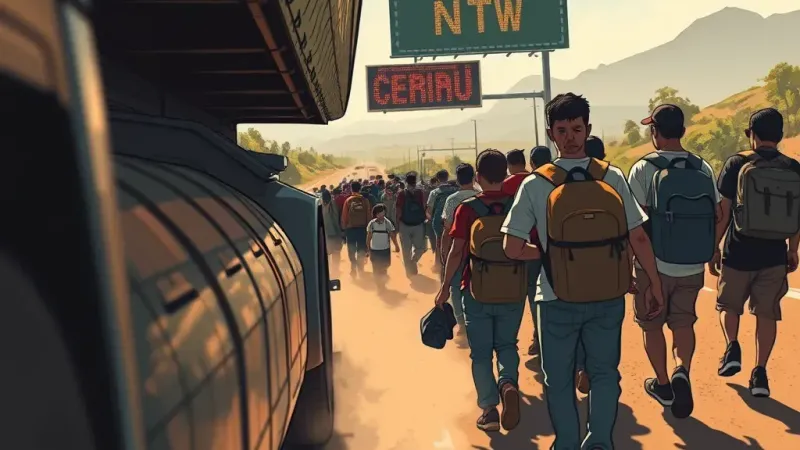
President Trump threatened higher tariffs on Mexico over a migrant caravan, as Texas Public Radio | TPR reported. The unfolding situation brings fresh attention to the complex intersection of cross-border trade, domestic political polling, and shifting population movements along the southern border.
The official framing treats the movement of people as an immediate crisis requiring aggressive economic leverage, utilizing tariff threats as the primary instrument of policy enforcement against a neighboring sovereign state.
The catch is that while political actors lean heavily on tariff threats to signal strength, the sheer volume of integrated commerce means that any escalation carries severe financial implications for domestic industries and border states alike.
To understand the scale of that exposure, consider the sheer volume of commerce moving through the region. Texas traded three hundred one point eight billion dollars in goods with Mexico last year. That massive financial figure represents the bedrock of regional supply chains, manufacturing inputs, and cross-border commerce, illustrating precisely how much economic activity is exposed whenever trade penalties are brandished as a political solution.
Meanwhile, the population movement driving these policy threats involves a migrant group estimated between one thousand and two thousand people. This moving demographic has become the focal point of intense political friction, even as officials across the border offer drastically different assessments of the situation on the ground.
Mexican President Claudia Sheinbaum downplayed the migrant groups, pushing back against the alarmist framing often accompanying such caravans in political discourse. President Claudia Sheinbaum minimized the operational significance of the moving population, presenting a direct counter-narrative to the warnings emanating from Washington.
Yet the domestic political appetite for aggressive posturing is not happening in a vacuum. Domestic leaders are watching their political standing shift alongside public frustration with border management. Support for immigration handling dropped nine points since May 2025. This notable downward slide in approval numbers reveals why political actors may feel compelled to adopt harder lines, as confidence in official handling erodes over time.
When a migrant group estimated between one thousand and two thousand people triggers threats of higher tariffs from President Trump, while Mexican President Claudia Sheinbaum downplayed the migrant groups, the underlying friction is driven by more than just border logistics. It reflects a domestic political environment where support for immigration handling dropped nine points since May 2025, intersecting directly with an economic corridor where Texas traded three hundred one point eight billion dollars in goods with Mexico last year. The numbers tell a story of immense financial interdependence colliding head-on with volatile political pressures, leaving policymakers to weigh the cost of economic retaliation against the reality of integrated markets.